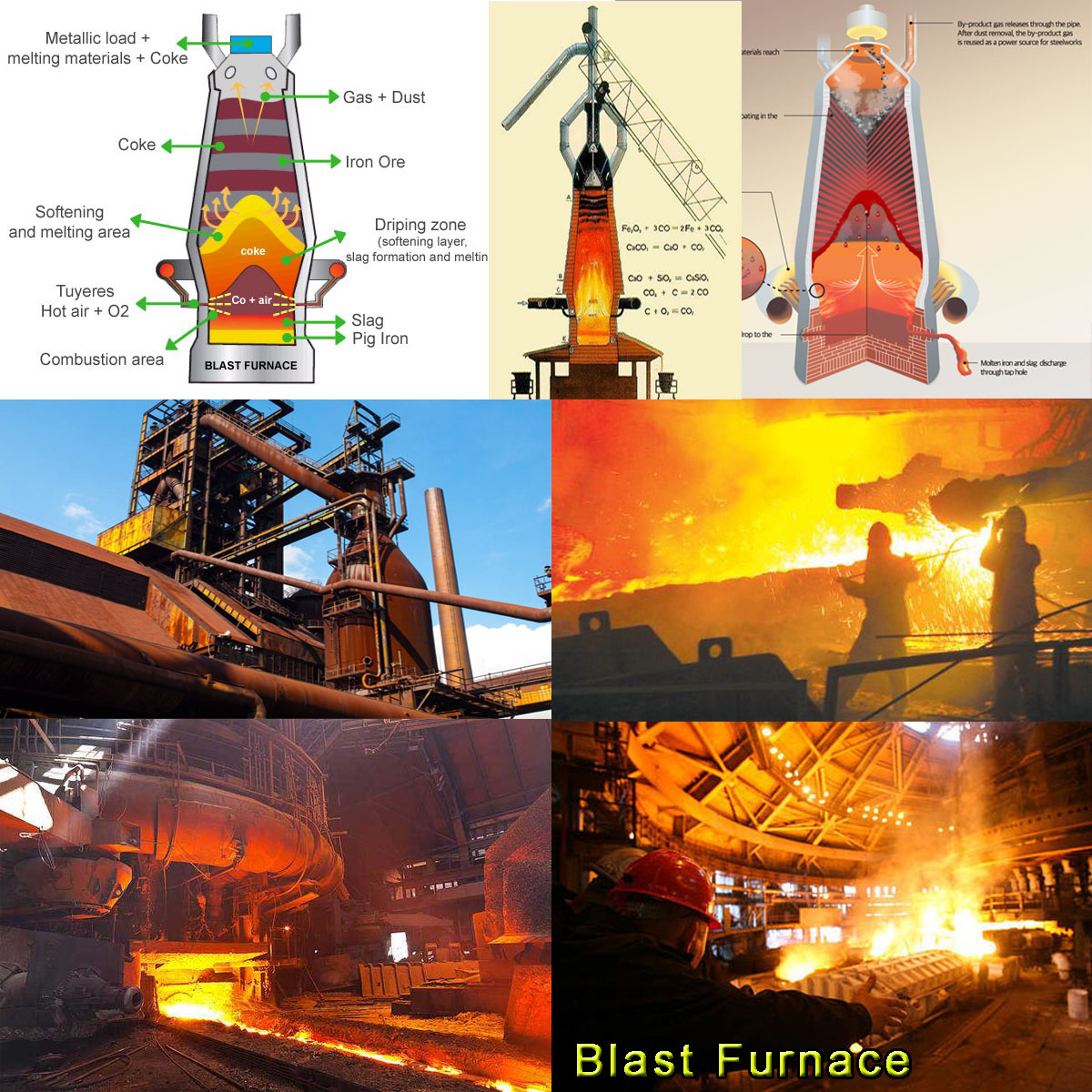
Blast furnace is the main equipment for ironmaking, and clay brick is the earliest furnace lining material used in blast furnace. Blast furnace has the advantages of large output, high productivity and low cost, which is unmatched by other ironmaking methods.
The refractory materials and refractory bricks used in diffreent parts of blast furnace are as follows.
(1) Furnace hearth
One of the main functions of furnace hearth is to hold molten iron safely. The hearth refractory material must be stable enough when the temperature is highter than 1500 ℃. So for furnace hearth bottom, we need to choose carbon brick which has the advantages of anti-molten iron penetration, good melting, alkali resistance erosion, good thermal conductivity. And we can use small carbon brick to take the place of large carbon block, or construct ceramic rings on the carbon bricks.
(2)Tuyere zone and bosh
Temperature in tuyere area and furnace bosh is the highest in the blast furnace. The hot gas temperature produced in front of the tuyere rises at a high speed, the temperature can reach 1600 ℃ and higher. When 1450 ~ 1550 ℃molten iron and slag flow furnace hearth and finally flow to the furnace bosh, there will be a variety of metallurgical reactions happen in this area violently. Those two areas need refractory materials with characteristics of good resistance to high temperature and slag erosion, good alkali resistance, anti carbon dioxide and anti water oxidation. China refractory bricks we can use in this area are corundum brick, alumina carbon brick, hot pressed semi-graphite carbon brick, SiC brick and so on.
(3)Furnace bosh and lower furnace stack
The lower furnace stack is the position of root cohesive zone where the temperature is quite high, but slag layer or stable slag layer self protection can not be formed. This are need ds refractory materials which can bear severe temperature fluctuations, and also has advantages of alkali metal erosion, zinc erosion, carbon monoxide erosion, etc. What’s more, refractory materials used in furnace bosh and lower furnace stack should have good thermal shock stability, high temperature resistance, good alkali resistance and other properties. Refractory bricks can be used in these two areas are high alumina brick, corundum brick, alumina carbon brick, SiC brick and so on.
(4)The middle and upper part of furnace stack
The furnace stack middle part’s temperature is lower than that of furnace stack lower part. People genarally use high alumina brick, corundum brick and silicon carbide in furnace stack middle part. The temperature in furnace stack upper part is relatively lower than other parts, and it mainly affected by the wear and impact of the burden, alkali metal, zinc and carbon deposition erosion. This area requires refractory material has advantages of good wear resistance, good alkali resistance and good thermal shock stability.?Refractory bricks can be used in this area are clay brick, high alumina brick, sillimanite brick, corundum brick. There is a trend that cooling walls are taking the place of refractory bricks used in blast furnace.
Article Source: Refractory bricks used for different parts of blast furnace
Company name: Henan Xinmi Changxing Refractory Materials Co.,Ltd
Email: sales1@chinafirebrick.com
Website:http://www.chinafirebrick.com